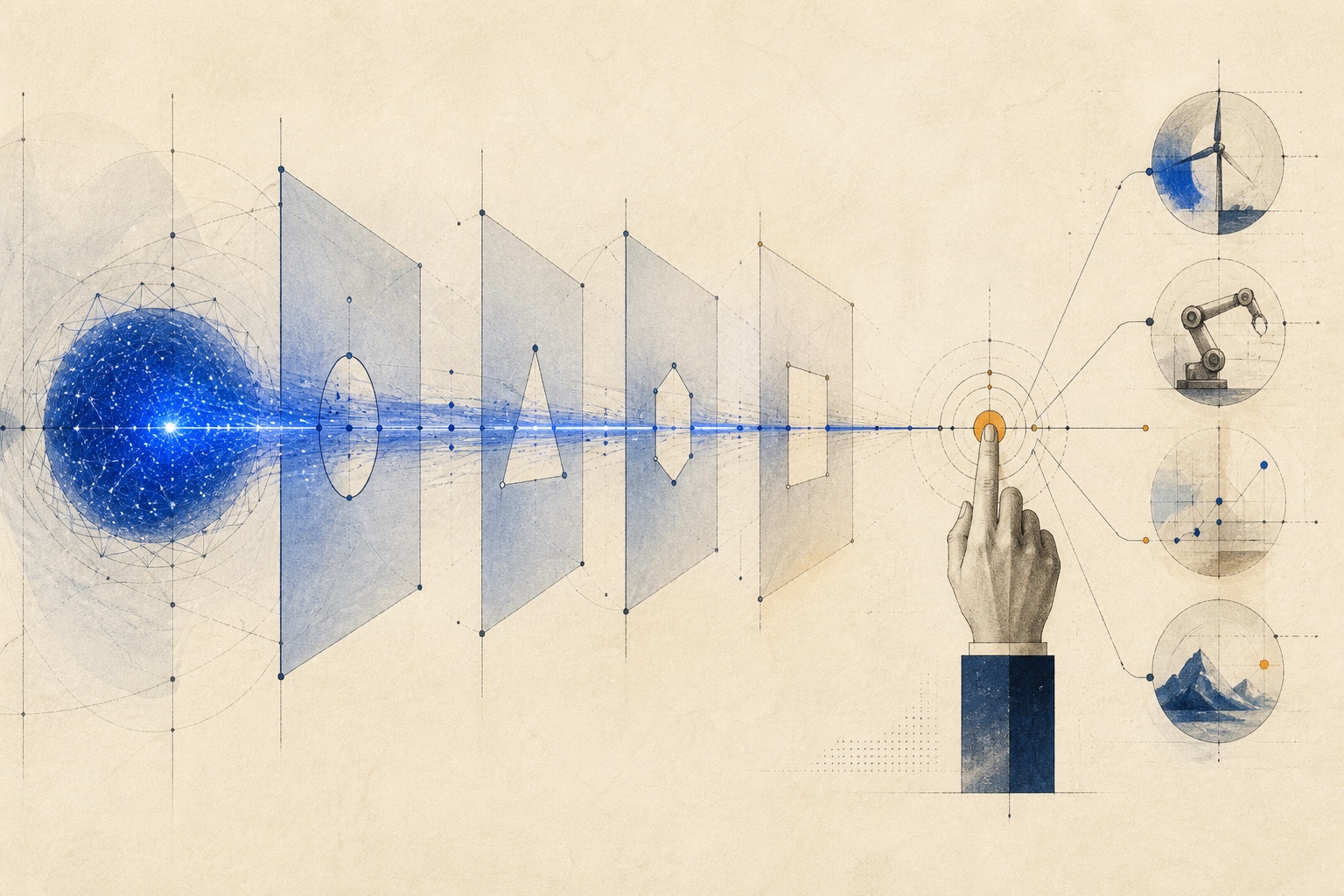
Start with the work, not the model
When a new AI capability appears, the natural reaction is to ask what we can build with it. That is useful for exploration, but it is a poor starting point for a product.
The better question is simpler: which decision or workflow should become meaningfully better?
That question changes the conversation. It moves the team away from demonstrations and toward outcomes. It also makes the constraints visible early: who uses the result, how often, what happens when it is wrong, and how much delay or uncertainty the business can accept.
A small improvement can be the right product
AI does not need to replace an entire process to create value. A useful first version might reduce the time spent finding relevant information, give a specialist a better starting point, or identify the few cases that deserve human attention.
These applications are often less exciting in a demo. They are more likely to survive contact with the organisation.
The important measure is not how impressive the output looks in isolation. It is whether the person responsible for the work can make a better decision with less effort and appropriate confidence.
Make failure part of the design
Every AI product has an uncertainty budget. Some errors are recoverable; others create financial, legal, operational, or reputational damage.
Before implementation, define:
- what a good result looks like;
- which errors are unacceptable;
- when the system should ask for help;
- how performance will be monitored after launch.
This is not bureaucracy around the product. It is part of the product. A system that knows when to be uncertain is often more useful than one that sounds confident all the time.
The practical test
Before adding AI, write one sentence:
We are making this decision or workflow better for this person by improving this measurable outcome.
If the sentence is difficult to complete, the team probably needs more problem definition before more technology. Once the intended improvement is clear, the choice between a model, a retrieval system, an automation, or ordinary software becomes much easier.
Useful intelligence starts with a useful question.
Continue reading
The AI Pilot Worked. So Why Did Nobody Use It?
A good demo proves that AI can produce an answer. Adoption depends on whether the answer fits the work.

Your AI Agent Needs a Job Description
AI agents need explicit identity, permissions, approval rules, and audit trails. Define their authority before they enter production.