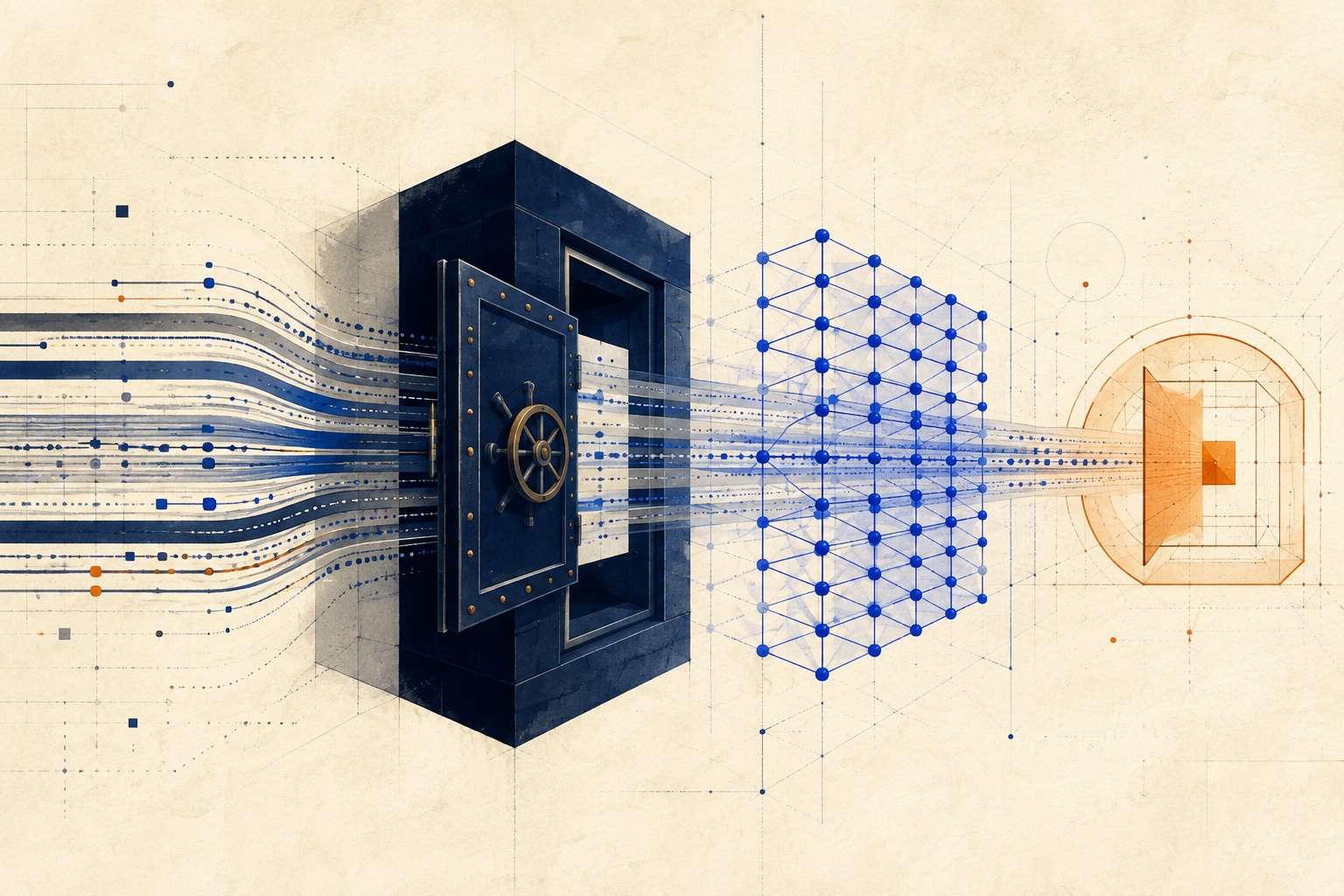
AI safety monitoring creates a second data system—often before anyone has designed it as one.
An agent may process customer records, internal code, legal advice, or incident details. To detect misuse across sessions, the monitoring layer may need to retain and correlate parts of that activity. The original workload can be tightly governed while its safety logs quietly become a new collection of sensitive data with different readers, retention rules, and failure modes.
Anthropic made this tension unusually visible on September 1 when it announced Enterprise Frontier Safeguards. The planned service is designed to keep activity data used for monitoring in cloud infrastructure controlled by the customer, under the customer's keys, access policies, and audit logs. Automated systems analyse a rolling window and route flags to the customer's team; human review by Anthropic is not required.
The useful idea is larger than one vendor feature:
The team that operates a detector does not have to own the data it inspects—but somebody must own every boundary between them.
That is a data-product problem. It needs a contract.
Monitoring is not just a logging toggle
Ordinary application logs usually answer operational questions: did a request fail, how long did it take, which service handled it? AI monitoring can carry much more context. Prompts, responses, tool calls, retrieved documents, user identifiers, and session links may be needed to distinguish one strange interaction from a pattern unfolding across accounts.
That context makes detection stronger. It also raises the consequence of a weak control. A security log can reproduce the secret it was meant to protect. A cross-session identifier can reveal a relationship the source systems kept separate. A long retention window can outlive the business reason for collecting the data.
This is why "we do not train on it" is only one line in a much larger design. Teams still need to know where activity is stored, what the detector can read, what derived signals leave the environment, who can inspect a flag, and when every copy disappears.
AWS's September 1 GovCloud announcement confirms the customer-controlled-cloud pattern for eligible deployments. Anthropic says the EFS rollout will begin in phases later this fall, so it should be evaluated as an announced architecture rather than an already proven operating result.
Write the contract around the data path
Before enabling production monitoring, put six clauses in one reviewable record. Keep them specific enough that security, data, product, and operations teams can test the same promises.
| Contract clause | Decision to record | Evidence to retain |
|---|---|---|
| Capture | Exact events and fields collected; fields excluded or redacted | Versioned schema and sample event |
| Custody | Storage account, region, encryption key, and access owner | Resource policy, key policy, and access log |
| Detection | Detector operator, readable fields, correlation window, and rule or model version | Deployment version and test result |
| Decision | Flag severity, recipient, response time, and false-positive route | Alert receipt and case state |
| Investigation | Who may inspect raw activity and under which approval | Reviewer identity and access justification |
| Deletion | Time-to-live, legal holds, derived data, backups, and failure handling | Deletion receipt and exception report |
Do not let "customer controlled" substitute for these answers. A bucket in your account is not automatically a governed product. The detector still needs a documented read path. Reviewers need narrowly scoped access. Key rotation, regional copies, backups, and egress need owners. Deletion needs a verifiable outcome, not only a lifecycle setting.
Separate four kinds of responsibility
A good architecture keeps four roles visible even when one team fills several of them.
- The workload owner decides which use cases and users may generate monitored activity.
- The data custodian controls storage, keys, access, residency, and retention.
- The detector operator maintains the automated logic and explains what a flag means.
- The incident owner decides whether to contain, investigate, clear, or escalate the event.
Separation prevents a familiar failure: a provider produces a flag, a platform stores it, and a business team assumes somebody else is investigating. The alert exists; accountability does not.
This direction also fits the broader standards work. NIST's Control Overlays for Securing AI Systems project is developing implementation-focused controls for generative AI and single- and multi-agent systems, explicitly covering confidentiality, integrity, and availability. Vendor-native safeguards should map into that enterprise control environment rather than form a parallel governance island.
Test the contract with receipts
Architecture diagrams are useful, but production readiness needs evidence. Run a safe canary event with a known signature and confirm that the complete chain works: the right fields are captured, the detector sees the allowed window, the correct team receives the flag, and raw activity remains unavailable to identities outside the approved review path.
Then test the failures. Revoke the detector's key. Delay the alert. Send a duplicate event. Expire the data while a case is open. Simulate a regional outage. Confirm whether the system fails closed, fails visible, or silently creates a gap.
Track a small set of operating measures: capture completeness, detector latency, alert delivery, reviewer response, confirmed false positives, missed canaries, and deletion exceptions. None proves that the detector will find every novel misuse. Together they show whether the monitoring product itself is dependable.
The emerging privacy architecture is encouraging because it separates custody from detection and puts human review closer to the organisation that understands the context. But moving logs into a customer account does not move responsibility automatically.
Before the first production session, draw the entire monitoring data path. Name the owner at every boundary. Decide what evidence proves each handoff and deletion. If the team cannot answer who can see an AI activity record, why they can see it, and when it will be gone, the safety system is not governed yet—it is simply another sensitive dataset.
Continue reading
An AI Agent's Reasoning Is Not an Audit Log
Reasoning traces can become shorter or less revealing as models improve. Build the audit trail from actions, policy decisions, and receipts instead.
AI Agent Controls Need a Portability Test
A policy that works in one agent framework is not yet an enterprise control. Test whether decisions, enforcement, and evidence survive a runtime change.